

According to a recent report by Niko Partners, the video game market in Asia and the Middle East is projected to reach $88.97 billion by 2025, an increase of 2.7 per cent over the same period, and the total number of players is expected to grow at a synchronized rate of 2.7 to 1.7 billion, driven mainly by:
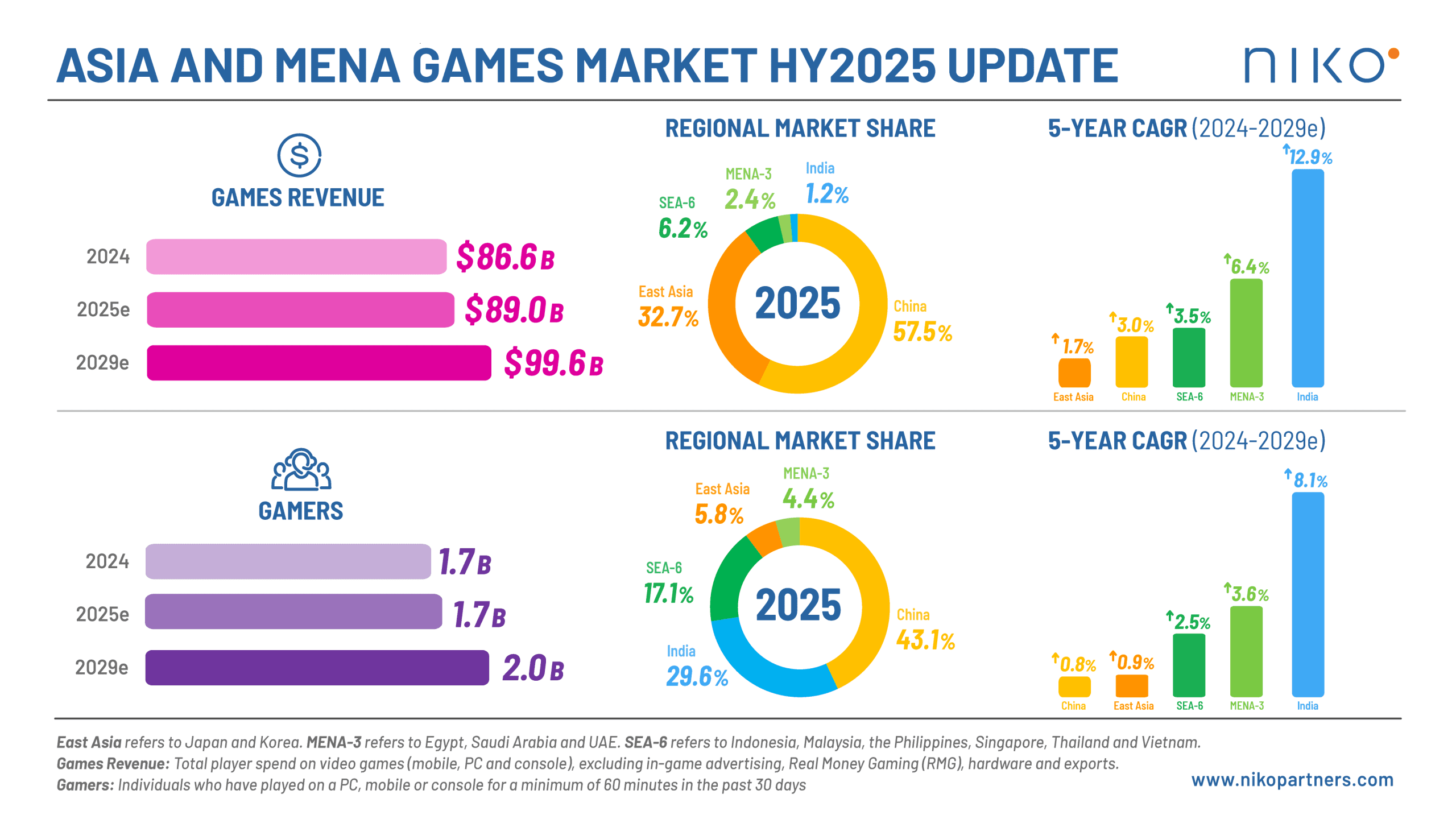
Moving and PC game growth is higher than expected:(a) The long-green IP continues to grow, and new cross-platform games that provide 3A-level experience contribute to market dynamics;Payer base expanded:(b) The increase in the number of fee-paying players in the two regions and the acceleration of overall income increases on the basis of existing fee-paying groups;Improved regulatory environment:(a) To improve the local game market, with previously closed platforms gradually opening up access to external liquidity;Audience outreach:Increasing market coverage by reaching underserved user groups, including growing female players and emerging interest groups of subdivided types;Host plate outlook:The growth of software and services is driven by Switch 2 in Nintendo, Roarers 6, and subgenerational hardware from manufacturers like Sony and Microsoft. India ‘ s market under the dual dividend of regulation and population structureBy 2029, India, the Middle East and South-East Asia will be the fastest growing region in terms of income and player numbers. Among them, India, the Middle East and China will show the strongest growth in average per user income, with India predicting that by 2028, player spending will have exceeded $1.5 billion, leading the growth boom. The number of Indian players is expected to reach 500 million this year, which will rise to 700 million by 2029. The Online Game Regulatory Act (PROG), introduced in India in August 2025, effectively prohibits gold games, while the Government has increased its support for video games and the electric competition industry, which is seen as a positive signal of intent to foster the development of the local game and the electric competition industry.

South-East Asian markets with opportunities and challengesMalaysia, Thailand and Viet Nam will be the fastest-growing markets for income growth in South-East Asia, while Indonesia will slow down as a result of the difficult economic situation. Despite strong growth in Malaysia, the Philippines and Viet Nam, Thailand and Indonesia are expected to decline as a result of consumer confidence and regulatory environment variables. Viet Nam ‘ s macroeconomic indicators show strong growth momentum, coupled with government support for the game industry, which has led to an upward adjustment of its revenue expectations. Grown-up markets are the foundation of the green.As the most mature markets in Asia and the Middle East, China, Japan and the Republic of Korea are expected to contribute $888 billion in player spending in 2029, accounting for 89.1 per cent of the 13 market revenues tracked by Niko Partners. Given the strong growth of the South Korean market and the successful marketing of Switch 2 in Japan, the projections for November 2025 are more optimistic: South Korean game revenues are expected to rise as major producers increase their revenues this year; and the strong performance of China’s old and new game has led to a full-scale upward revision of its platform-wide expected data to 2029.

Host market share is growingAlthough in 2025 the mainframe game accounted for only 6.3 per cent of income in Asia and the Middle East and North Africa, it will become the fastest growing subsector by 2029 as Nintendo expands its regional layout through Switch 2 and increases its spending on free games and multi-play subscription services. Looking ahead, it is hoped that the sale of the Manhunter 6 will increase the spread of the host throughout the region. The growing demand for 3A experience and quality games in the market is increasing the consumer willingness of players to host games, which may be beneficial for Sony and Microsoft’s next generation hosts.